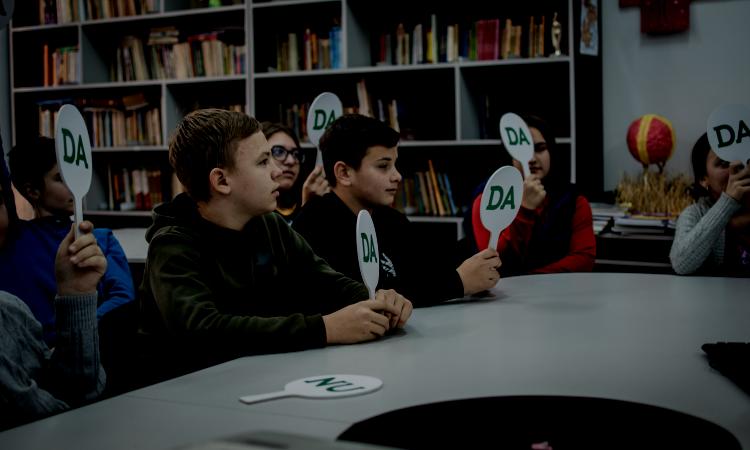
"I miss home, because of the war I do not have the opportunity to go to school, play with friends, live a quiet life and see my relatives who stayed at home," wrote a 14-year-old boy from Ukraine, currently living in Romania.
His words echo the experiences of many children affected by the war. A new report published by Terre des hommes (Tdh) and the Centre for Children's Rights at Queen's University Belfast (QUB) shares what Ukrainian children say about their lives during the conflict and what they want adults to do to support them.
Armed conflicts can have serious impacts on children's rights guaranteed under the United Nations Convention on the Rights of the Child (UNCRC), including the right to safety, food, water, healthcare, education, and a secure home, as well as their right to be heard (Article 12), a principle that is difficult to uphold in humanitarian crises.
Although there is growing evidence that children and youth can meaningfully contribute to relief, recovery, and reconstruction processes, their perspectives are often overlooked by adults in both research and practice.
To address this gap, Terre des hommes and the Centre for Children's Rights at Queen's University Belfast developed a child rights-based online survey for Ukrainian children affected by the full-scale invasion. Children were involved in designing the survey itself and in shaping recommendations about healthcare, education, play, safety, and standard of living.
The report presents what children in Ukraine and those who fled to other countries shared about how the war has impacted their lives and what they want adults to do to support them. By listening directly to children, practitioners and decision-makers can better understand their real needs and priorities.
Read the Children's Rights in Ukraine Report in English and Ukrainian.
It is essential to recognize that children are not only victims of war, but they are first and foremost rights-holders, as well as contributors to solutions. Involving them in shaping responses lays the groundwork for stronger, community-owned child protection systems that respect and operationalise children's rights in full. To support such important processes, Tdh has also developed “Walking the JOURNEY amidst Challenging Circumstances”, a methodological toolbox to support the work with Children & Youth Advisory Boards in Ukraine. Available in both English and Ukrainian, the toolbox offers a range of knowledge and practical activities on how to safely, ethically, and meaningfully engage children and youth in advisory roles and decision-making processes.