
When the full-scale war in Ukraine began in February 2022, Victoria faced a decision no parent should ever have to make – to leave home in order to protect her children. They fled their hometown of Kamianske in the Dnipropetrovsk region, leaving behind everything familiar: stability and the life they had carefully built.
Victoria crossed the border into the Republic of Moldova on 6 March 2022 together with her two children – Melania, who was 4 at the time, and Danya, who was 6. It was the first time she had ever crossed a border.
“It was the first time our family tried to go somewhere together. Until the full-scale invasion, we had never managed to leave the country,” she recalls.
They arrived in Moldova and found temporary refuge in the village of Chirsova, in the Autonomous Territorial Unit (ATU) of Gagauzia. What began as an emergency solution gradually became the place where they started rebuilding their lives step by step. The first months were marked by uncertainty and intense emotional pressure.
“The first months were an enormous psychological stress. I simply could not accept that such things could happen in the 21st century,” she says.
At the same time, the children had to adapt to a new language, new classmates and unfamiliar routines while trying to process the experience of displacement. Enrolling in the local secondary school helped restore a sense of structure. Gradually, they made friends, adapted to the new environment and found a sense of normality in their daily lives.
A key moment for the family was when Victoria found a job. Having employment means financial stability, but also something just as important – dignity, independence and the feeling of regaining control over one’s life.
During this period, the support of the community and humanitarian organisations played an essential role.
“The greatest support were the people. Little by little, they helped me find myself again and understand that I had to move forward for my children,” Victoria says.
From the very first days in Moldova, the family was supported by the multidisciplinary mobile teams of Terre des hommes Moldova. Since the beginning of the war and the arrival of refugees, these teams – composed of a social worker, a psychologist and facilitators – have been reaching communities hosting refugees to provide psychosocial support, protection and practical assistance directly where vulnerable families live.
For Victoria’s family, this meant timely psychological support and safe activities for the children. The psychologist provided a space where both the mother and the children could speak openly about fear, uncertainty and change.
“At Terre des hommes I met people who believed in me at moments when I no longer had the strength to believe in myself,” Victoria says.
For her, this support meant more than practical assistance.
“When you are alone with two children in a foreign country, people like the Terre des hommes team are like a lighthouse. In their eyes, I sometimes saw myself as stronger than I felt.”
Creativity became an important part of the children’s adaptation process. In safe and supportive environments, they regularly participate in drawing and painting activities, and these moments help them regain confidence and a sense of safety.
Discover their paintings here. 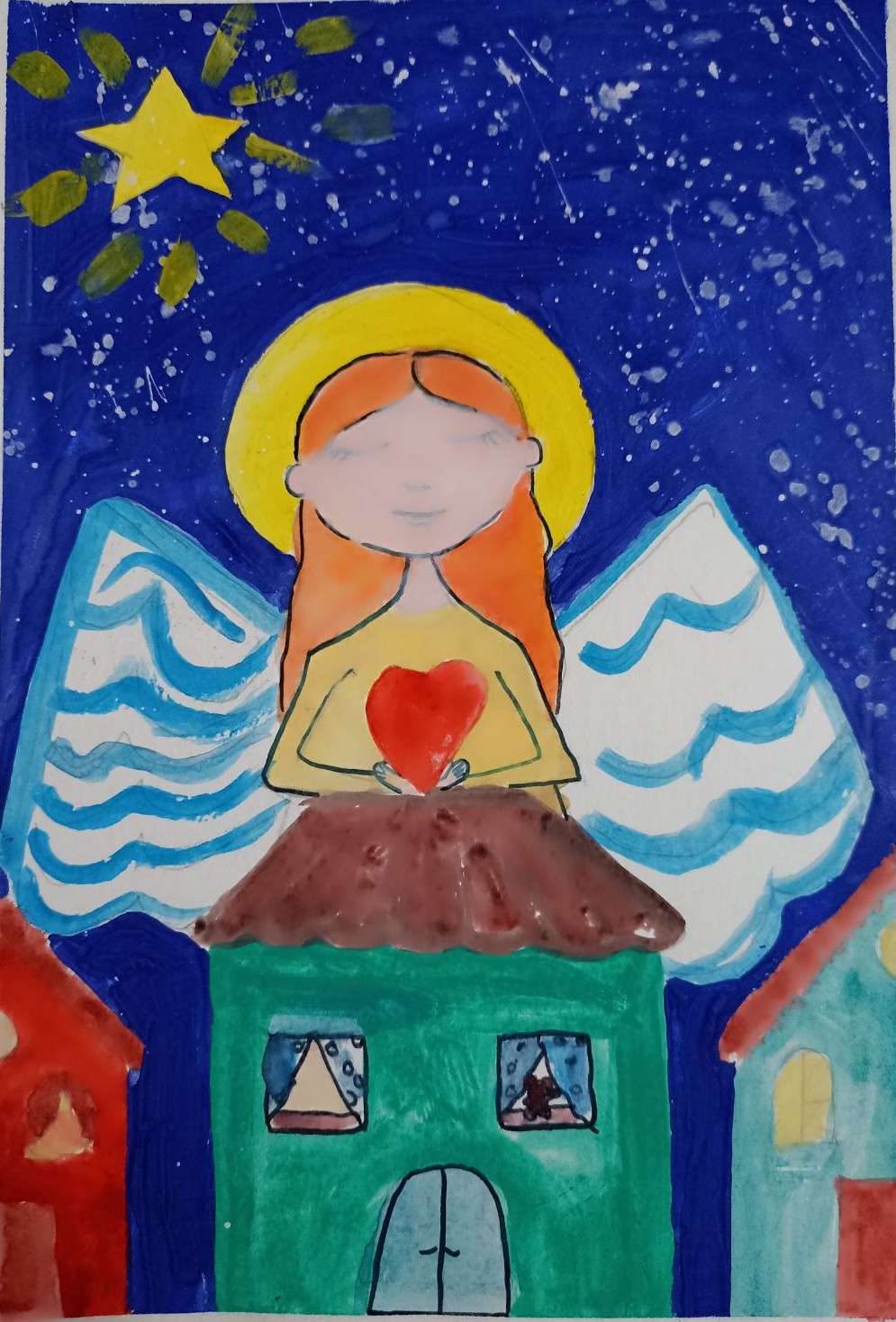
Victoria says that one of the most important moments came when she realised she needed to rediscover her self-confidence: “In August 2022, I understood that my life and the lives of my children were entirely in my hands.”
Practical support also contributed to the family’s progress. With the help of our social worker, they received support to purchase a tablet so that the children could continue their schooling without interruption.
Today, the children are active and involved not only in school activities: Danya, now 10, practises kickboxing, while Milania, now 8, does gymnastics.
“The children are grateful for the peaceful sky and for having a roof over our heads,” Victoria says. “They have their own bed, their own desk for school, and even pets – the cat Lizocika and the dog Jessie.”
Milania participates with great passion in aesthetic and artistic gymnastics and has represented the ATU Gagauzia and the Republic of Moldova at international competitions in Romania and Bulgaria, where she won prize places. Dania, in turn, has been practising kickboxing for more than three years and sees his coach as a mentor.
Over time, Victoria began to actively engage in community life. Through a project supported by the International Organisation for Migration (IOM), she organises socio-recreational activities and art-therapy events aimed at supporting the integration of Ukrainian refugees into the local community.
She is a mediator in ATU Gagauzia within the Ukrainian Women Refugee Network “Female Support Force” and volunteers with the Red Cross in Comrat, where she organises sports and artistic activities for children in summer camps, as well as with the organisation ProEuropa.
Wanting to help others going through difficult experiences, Victoria decided to study psychology.
“Psychology has interested me since adolescence. I practically grew up an orphan, and my grandmother taught me to love life regardless of circumstances and to always move forward.”
In 2025, she became a student at Comrat State University in the psycho-pedagogical module.“I realised that by learning to understand myself, I can make the world a little better every day.”
In everyday life, the family tries to maintain simple habits that help them stay close. “The happiest moments are those spent together as a family. At dinner, each of us shares the moment from the day that impressed us the most. That’s how we learn to notice the good things in every day.”
The family’s journey is still not easy. “I cannot say that our life has completely settled. Every day I still have to fight for every opportunity.” But step by step, Victoria and her children are rebuilding their lives.
And their story shows that support provided at the right moment can become the starting point for a new beginning.