The Building Bridges project aims to bolster the integration, wellbeing, and future prospects of Ukrainian refugee children and young individuals under 25, along with their families in Hungary (Budapest, Győr, Debrecen) and Romania (Bucharest, Brașov, Constanța) where we also support refugees from other countries.
Our impact
Since the start of the full-scale war in Ukraine in February 2022, Romania and Hungary have been hosting tens of thousands of people who were forced to flee their homes. As part of our continuous efforts to support Ukrainian refugee children and their families in these two countries, the Building Bridges project will enhance existing services, particularly in child protection and education, making them more accessible to refugee families. In both countries, we assist refugees by providing information to help them navigate the social system. In addition, in Romania, we offer access to temporary emergency accommodation.
The project also creates opportunities for children and young individuals from refugee and disadvantaged backgrounds to engage in innovative education and skill-development programmes utilizing digital technology. Furthermore, we facilitate activities aimed at improving mental and psychosocial health and support the creation of youth initiatives that promote critical thinking and civic engagement. Our overarching goal is to empower the refugee community and foster resilience.
Resilience Innovation Facilities (RIFs)
Terre des hommes operates RIFs in both Hungary and Romania. At these locations, we offer skill-building sessions in Ukrainian, Hungarian, and Romanian, where children and young people learn to use various digital tools and technologies, such as 2D/3D design, 3D printing, laser cutting, sticker making, and engraving on materials like wood, cardboard, artificial leather, and metal. Additionally, they have opportunities to customize textiles and ceramics and engage in digital sewing and embroidery. These activities not only aim to enhance participants' digital literacy but also to introduce them to a wide range of creative digital media. All digital skill development sessions are complemented by activities designed to improve the participants' emotional well-being.
In addition to skill-building workshops, we also offer Hungarian as a foreign language and catch-up classes in the Budapest RIF, as well as in schools upon request.
In both countries, we organise summer camps for children, and we provide administrative and financial support to help teenagers on the move (refugees, asylum seekers, migrants) turn their ideas into community-changing, technologically, artistically or socially innovative initiatives.
Strengthening capacities of child protection and education actors
Within the project, several effective, internationally applied methodologies that support the mental health and psychosocial wellbeing of displaced children, young people and adults, will be adapted to the Hungarian and Romanian context. We will further train child protection and education actors to apply these methodologies in their work.
- ICAM and ICAMucs methodology
The Including Children Affected by Migration (ICAM) training aims to provide primary and secondary schools with a methodology to support the integration of children affected by migration into the school community, while the ICAMucs programme focuses specifically on the school integration of children having fled from Ukraine. By focusing on the emotional and social needs of refugee youth, the programme aims to create a safe environment that helps children to improve in schoolwork and in all other areas of life.
- Problem Management+/PM+ (only in Romania)
Problem Management Plus (PM+) is a low-intensity, brief psychological intervention developed by the WHO. PM+ is designed to support young people over the age of 16, as well as adults who have experienced various forms of adversity. PM+ is delivered by PM+ helpers in the beneficiaries' native language, who are trained non-specialists supervised by a licensed, experienced psychologist. Those individuals requiring specialized mental health care are referred to dedicated mental health services.
- "I support my friends" methodology (only in Hungary)
This methodology is based on the Psychological First Aid (PFA) methodology developed by UNICEF, WHO, Save the Children and the MHPSS Collaborative. Its aim is to equip children and young people with the knowledge and skills to effectively support their peers in difficult situations.
- Quality of services
This training offers small NGOs, refugee-led, and community initiatives the opportunity to assess, with our assistance, how safe their operations, processes, and services are for children and how they provide space for meaningful child participation.
- Supervision and coaching
The training offers tools that help team leaders to provide professional and mental support to their colleagues. The aim of the training is to support professional development, enhance awareness and reflection, and prevent burnout, so that professionals can better serve their clients.
Information materials for Ukrainian refugees in Hungary
To support families from Ukraine with relevant information, we have developed two info packs:
- Our booklet "Child protection in schools" was created to inform parents of school-age children about the Hungarian education system and its child protection aspects. It also addresses topics such as school attendance rules, the responsibilities of teachers and school staff, as well as learning difficulties and bullying. The booklet is available in Hungarian and Ukrainian.
- The aim of the "Available services" information materials is to provide information for children and adults coming from Ukraine about NGO support services. The booklets cover the following types of services: extracurricular activities for children, language courses and psychological support. The materials are available in Hungarian and Ukrainian.
Learn more about the project and the methodologies applied in Hungary: English, Hungarian and Ukrainian.
Information materials for Ukrainian refugees in Romania
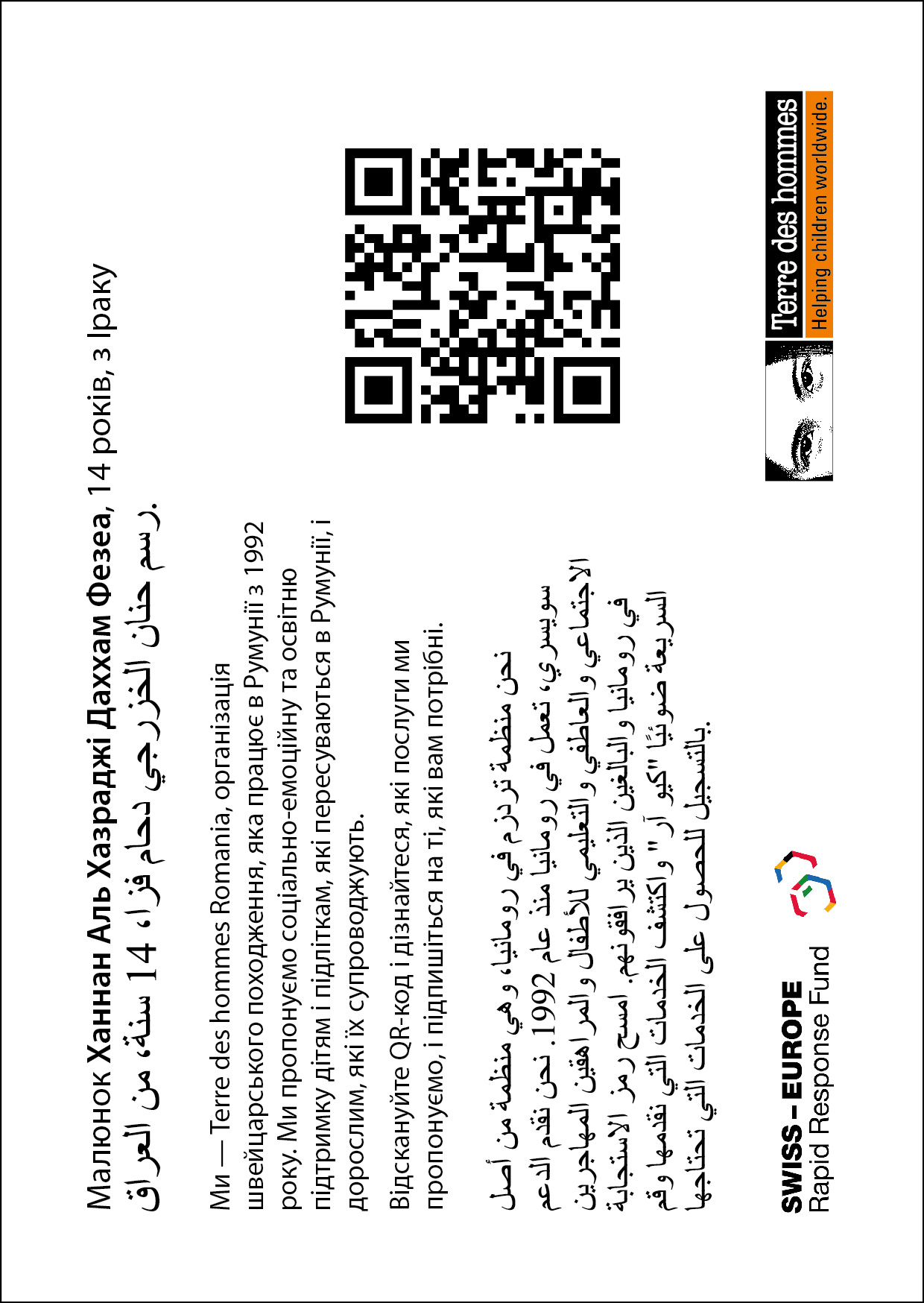
We have developed an information leaflet (in Ukrainian) for children on how to access their rights in Romania. Postcards were also created and shared to raise awareness about the project and provide access to services in Romania. The QR code on the postcard leads to this page with additional information about available services and a form where people can inquiry for further details.
The Building Bridges project is supported by the Swiss-Europe Rapid Response Fund and the Swiss State Secretariat for Migration - SEM.