Violence against children in and around schools remains a pressing issue across Europe, with various forms of abuse affecting students' well-being and development. Our CARING projects aim to reduce school-related violence by addressing harmful social and gender norms, strengthening multi-disciplinary responses, and promoting children’s rights-based participation.
Our impact
Evidence suggests that children in several European countries, including Bulgaria, Croatia, Greece, Romania, and Kosovo, face multiple forms of violence at school and in their communities. While each country has made progress through laws, policies, and practical measures, these efforts must be expanded and better coordinated to build effective child protection systems that truly prioritise the best interests of every child.
In the first CARING project, we focused specifically on gender-based violence. Building on that foundation, the second CARING project aims to address all forms of school-related violence.
Empowering schools through training and support
CARING projects equip teachers, school leaders, and facilitators across the five countries with tools to recognise, prevent, and address violence. Through adapted curricula and training methodologies, over 1000 school professionals gain skills to support gender equality, facilitate participatory learning, and become role models and advocates for change.
"No matter how much you know about violence, it’s never enough, because every case is so different that there’s a real need for ongoing training to best understand how to act," shares Simona Spirescu, Primary School Teacher at Ferdinand Secondary School in Bucharest, who participated in CARING’s first phase.
“I've become aware once again that only by supporting each other as teachers can we truly make progress. We need to understand that we must ask for help – we can always turn to colleagues who serve as resources at our school, or to colleagues who have gone through similar situations. We can even invite a colleague into our classrooms, during our lessons, to be an extra pair of eyes and to see certain situations that we might not be able to handle on our own.
By learning in this way, through close collaboration, we can achieve results. In this project, it was helpful for everyone to have some terms explained – terms we were dealing with but didn’t fully understand – like social norms, gender norms, child participation, and what it means to be a child-friendly school. Another important point is that change never happens overnight; it requires small steps, patience, and determination."
Ministries of Education and regional inspectorates, many of which endorsed the project, are provided with data and best practices to inform policy. Accredited training modules ensure lasting impact by embedding gender-based violence prevention into continuous professional development for educators.
Children as agents of change
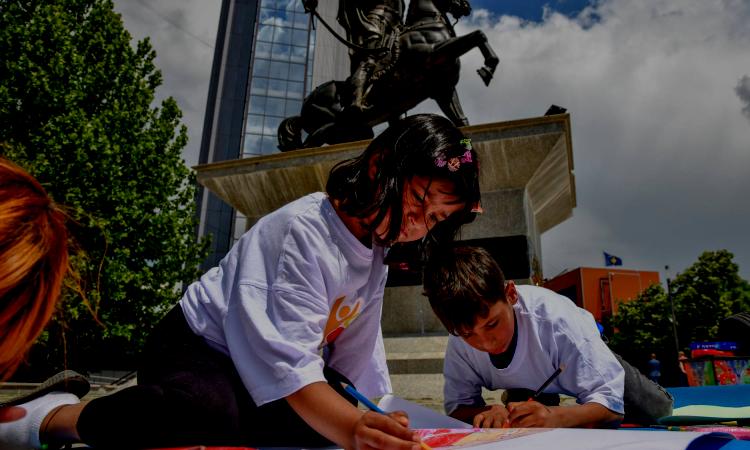
A core pillar of the CARING projects is promoting the active, rights-based participation of students through the creation of Child and Youth Advisory Boards (CABs) at national and regional levels. These Boards directly contribute to project decision-making by shaping strategies to prevent violence, developing evaluation criteria for child-led initiatives, and supporting the implementation and facilitation of regional activities.
Watch the video to see how, together with children, we are building safer and more caring schools.
In the first project, 715 children were engaged in assessing gender norms and violence in their school environments. Guided by trained staff, some of them designed and implemented 32 initiatives to promote positive behaviours and gender equality, reaching over 1,700 community members. The initiatives ranged from painting murals and creating safe spaces to producing short films and plays that raise awareness and propose solutions. "This experience allowed us not only to show our creativity, but also to decide what we think is important and how we should act upon it," shared a young participant.
Discover 12 child-led initiatives that were presented at the regional event of the first CARING project. Learn more here.
CARING 2.0 complements this approach by rolling out the “I Support My Friends” peer-to-peer methodology, which trains children and adolescents to provide psychological first aid and support friends in distress.
Strengthening multidisciplinary responses to violence
CARING projects recognise that sustainable change requires coordinated efforts across sectors, and that engaging parents is also crucial. The projects involve social workers, child protection experts, educational authorities and parents through networking meetings, thematic trainings, and joint activities.
In the second CARING project, we strengthen collaboration by improving and operationalising referral mechanisms within schools, establishing clear inter-agency referral pathways, and training multidisciplinary teams in trauma-informed care.
Knowledge sharing and policy influence
We create and disseminate thematic knowledge packages that address key aspects of violence in and around schools, such as disclosure practices, mental health impacts, and effective prevention models. Materials are shared via online webinars, conferences, newsletters, and the ChildHub platform, fostering an online community of practice. Stakeholders across Europe are empowered to replicate successful approaches in their own contexts. Through strategic partnerships and public institution engagement, CARING projects scale its impact, helping to institutionalise gender-sensitive, child-centred responses to violence in schools.
Interested professionals can learn more at the following links:
- Trauma-informed care: a training package to transform practice Download
- Companion tool I: Stronger voices, safer schools: heard, valued, driving change – implementation guide and toolkit
- Companion tool II: Not in my class, not in my chat!
***
The “CARING – Challenging social and gender norms to reduce violence against children in school” project was implemented from May 2023 to April 2025 under the leadership of Terre des hommes Romania. The “CARING 2.0 – Multi -disciplinary Prevention of and Response to School-related Violence” project is being implemented from April 2025 to February 2027 under the leadership of Terre des hommes Hungary.
The projects are implemented in partnership with Terre des hommes Romania, Terre des hommes Hungary, Terre des hommes Hellas, Terre des hommes Kosovo (only CARING 2.0), Brave Phone (Hrabri Telefon) in Croatia, the Institute of Social Activities and Practices (SAPI) in Bulgaria, and the Association Roditeli in Bulgaria.